A 10-question checklist to help leaders compare digital well-being tools for their population.
Digital well-being tools for students are multiplying, and many of them make similar promises. Choosing the right one comes down to five areas: product quality, research evidence, student engagement, system integration, and safety & privacy. The 10-question checklist below helps you compare vendors side by side and look past the pitch. Here is the core question for each area:
Digital well-being tools can extend preventive support to more students than counseling staff can reach alone. Product claims, evidence quality, and safety practices vary widely across vendors. AI-powered tools add new questions about crisis response, human oversight, and how student data is used.
A shared checklist gives counseling, student affairs, IT, legal, and procurement teams one framework to review vendors side by side. It also turns marketing claims into questions a vendor must answer with documents, data, and published research.
Each question below includes what a strong answer looks like. Ask vendors to answer in writing and to share supporting documents.
A strong product starts with sound science: content designed by psychologists, grounded in established techniques, and delivered through software that works reliably. It also has to earn students' limited attention, which they divide among coursework, jobs, family, and many other apps.
1. Is the product scientifically grounded and well built? A strong answer shows the product was designed by psychologists, is based on established evidence-based techniques, and runs reliably without major technical bugs.
2. Will our students want to use it? A strong answer shows an engaging and attractive design, high ratings in app stores and from students, and vendor support for campus activation and marketing. Strong evidence matters little if students never open the app.
Engagement figures and testimonials indicate interest, but they cannot show whether a tool improves student well-being. A randomized controlled trial with college students is the clearest test of whether a product's claims hold for a population like yours.
3. Have the product's claims been tested in a randomized controlled trial (RCT) with college students? A strong answer points to a published RCT of this specific product, with college students as participants. Evidence from a related app or a general adult population does not transfer automatically.
4. Is the study high quality? A strong answer includes a large sample, a long follow-up period, preregistration, and publication in a peer-reviewed journal. These features indicate how much weight the findings can bear.
Preventive benefits depend on students returning over time. Campus-level reporting lets you see who is engaging, identify student groups the tool is missing, and track whether outcomes change.
5. Will students keep using it? A strong answer shows lasting value, plus enough content and habit-building features to support repeated use.
6. Can we track engagement and outcomes? A strong answer includes campus usage data, engagement broken down by student group, and outcome measures the institution can review.
A tool delivers more value when it reflects your students and points them to services your campus already offers. Tools that other offices can use spread both the cost and the benefit.
7. Is it tailored to our campus? A strong answer shows content that fits your students, your campus resources built into the product, and resources that are easy to update.
8. Can it support other campus initiatives? A strong answer shows the tool can support stepped care, peer coaching, well-being campaigns, residence life, and learning centers.
Any tool that supports student well-being will at times encounter a student in crisis. Clinical oversight, safety event reporting, and clear data practices protect both students and the institution.
9. Does it respond well to students in crisis? A strong answer describes automated risk detection, human review, and connection to campus crisis services.
10. Are safety and privacy protected? A strong answer includes clinical oversight, safety events reported to the campus, limits on using student data for AI training, a clear process for data deletion, and compliance with applicable privacy laws such as FERPA, HIPAA, and GDPR.
Score each question for each vendor: 2 for a strong answer, 1 for a partial answer, and 0 for a weak or missing answer. Add the scores for a total out of 20. Copy the scorecard below to compare up to three vendors.
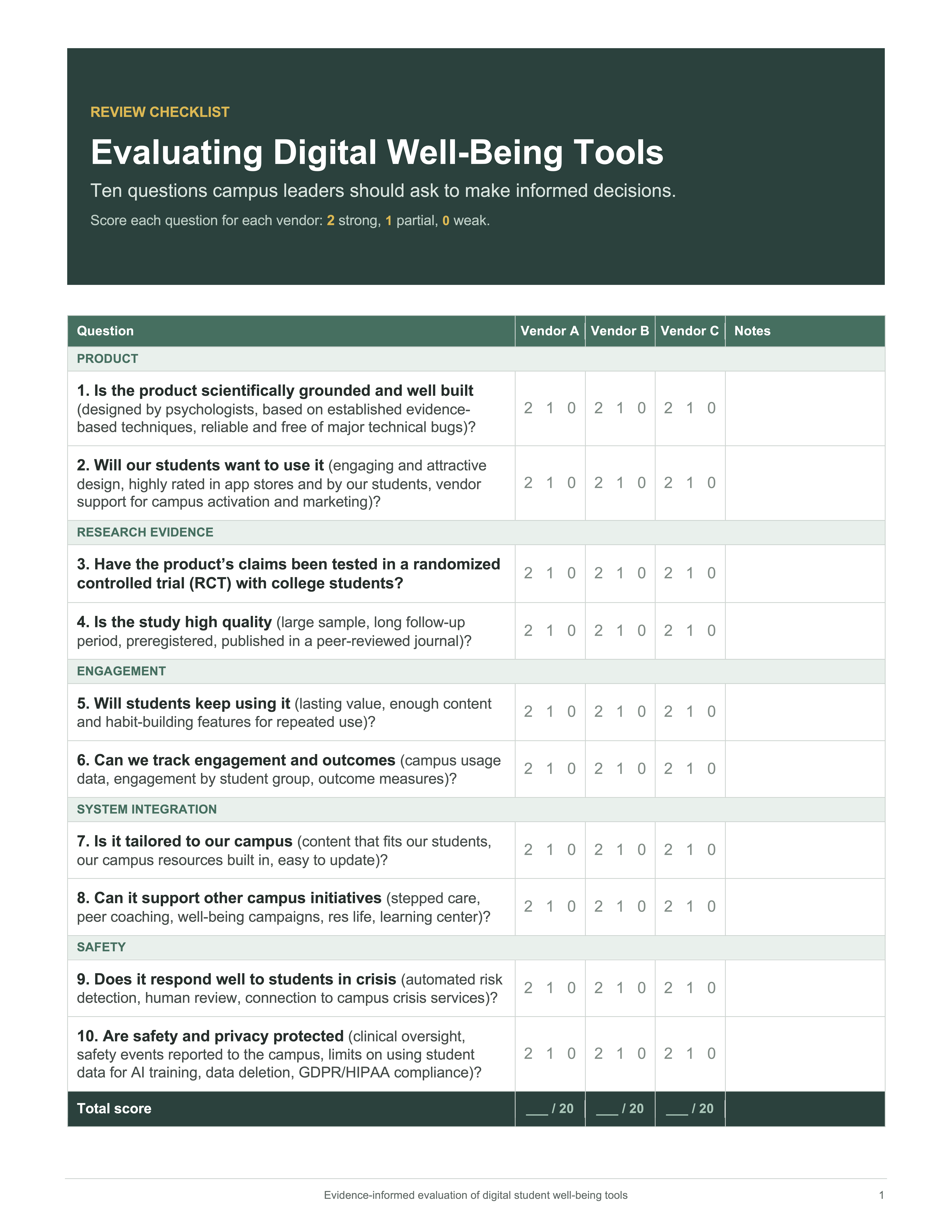
Download the scorecard and evaluation rubric here.
A strong pre-purchase review is only the beginning. Before deployment, establish success measures, governance responsibilities, and a review schedule.
Depending on the program, success measures may include adoption, sustained engagement, student experience, safety events, service utilization, well-being outcomes, and longer-term academic indicators. Name an owner for each measure and set a date for the first review.
A digital well-being tool is an app or online platform that helps students build skills for stress, mood, sleep, relationships, and other parts of well-being. Many now use AI to personalize support. Campuses typically offer these tools as preventive support alongside counseling and other services.
The strongest evidence is a randomized controlled trial of the specific product with college students. Look for a large sample, a long follow-up period, preregistration, and publication in a peer-reviewed journal. Testimonials and download counts show interest, but they do not show effectiveness.
An RCT randomly assigns participants to use the product or to a comparison condition. Randomization makes it possible to attribute differences in outcomes to the product itself. Without it, improvements may reflect time, other support, or which students chose to use the tool.
Ask how the tool detects crisis risk, when humans review flagged conversations, and how students are connected to campus crisis services. Also ask who provides clinical oversight and how safety events are reported to the campus.
Ask what student data is collected, who can access it, how long it is kept, and how students can delete it. Ask whether student data is used to train AI models, and how the vendor complies with applicable laws such as FERPA, HIPAA, and GDPR.
Look at app store ratings, student feedback from pilots, and repeat use over time, beyond initial downloads. Ask whether the vendor provides campus activation and marketing support, and whether the app has enough content and habit-building features to bring students back.
No. Digital tools work best as one layer of support within a broader system, such as a stepped care model. A well-integrated tool points students to counseling and other campus services when they need more support.
This checklist was developed by Flourish Science, a public benefit corporation, to help campuses review digital well-being tools.
Built by psychologists, the Flourish app is evidence-based and safety-first. Its effects on students have been tested in two large-scale RCTs, and student safety guides how every feature is designed and deployed. The app is highly rated by students and clinicians, has won multiple design awards, and is frequently ranked first by students. Flourish builds campus resources into the platform and encourages students to reach out for support, while keeping campus leaders informed through a real-time insights dashboard.

Generative AI is reshaping emotional support, but few tools are purpose-built on rigorous psychological science. Here is what we learned from bridging the gap.
Read more ➔
AI chatbots are everywhere, but most are not built for mental health. Here’s what you can do.
Read more ➔
An evidence-based, AI-powered approach to proactive student well-being, built for scale.
Read more ➔


Email hello@myflourish.ai to join us in this exciting movement, share a personal story, or simply send some good vibes. Your voice means a lot to us!