

An evidence-based, AI-powered approach to proactive student well-being, built for scale.
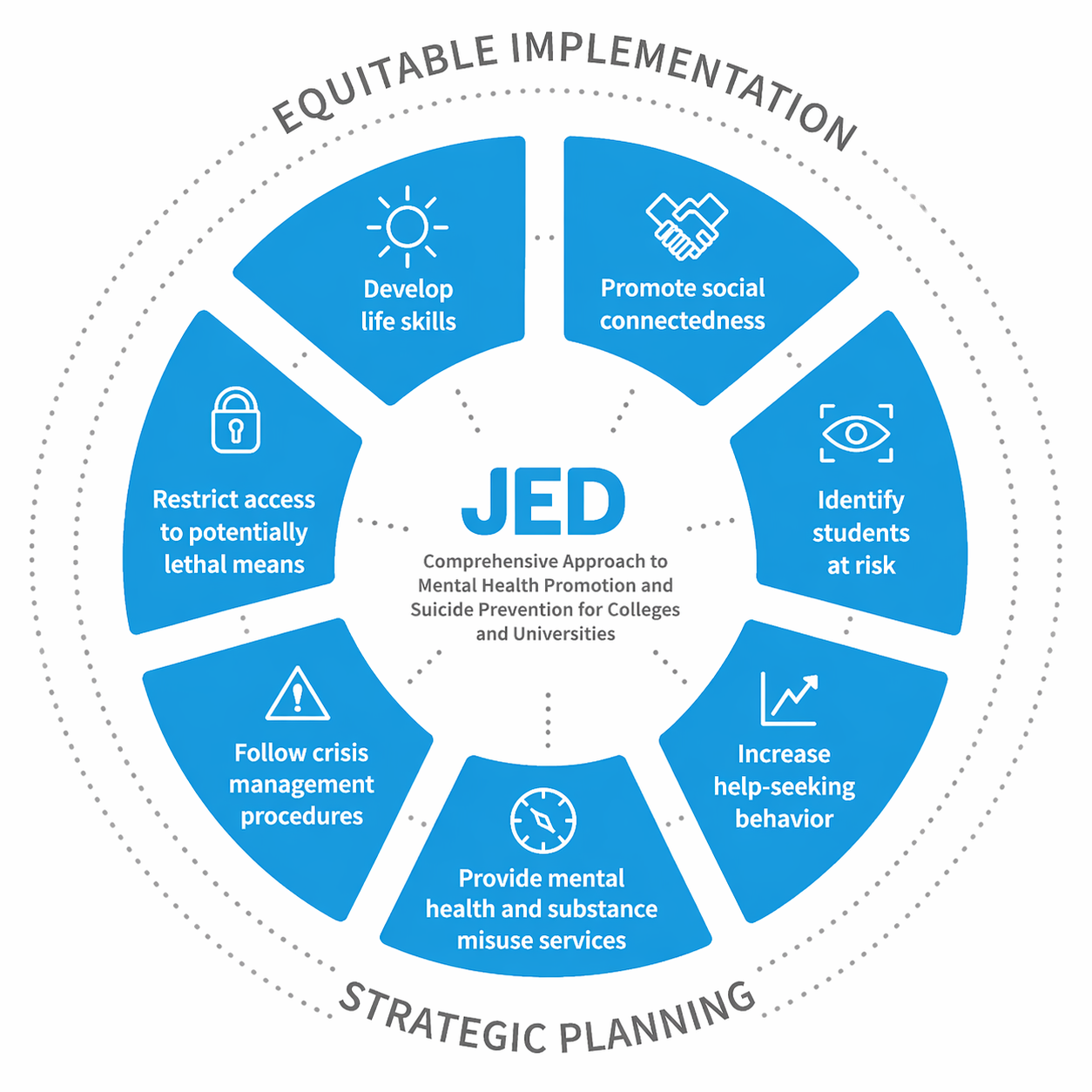
The JED Foundation's Comprehensive Approach is the gold standard for campus mental health systems. Over a decade of data from more than 500 campuses shows that JED institutions see students who are 10% less likely to report suicidal ideation, 13% less likely to make a suicide plan, and 25% less likely to attempt suicide.
The framework works because it is comprehensive, spanning the full spectrum from upstream resilience-building to crisis response. But comprehensive implementation requires reaching all students, including those who will never walk into a counseling center. Most campuses have strong services for students who show up. The challenge is everyone else.
Flourish addresses this gap by using technology to deliver scalable, cost-efficient, proactive, 24/7 well-being support across every domain of the JED wheel.
Flourish is a scientifically validated, AI-powered well-being platform designed to reach the students clinical services often cannot—the “yellow zone” students who are struggling but may wait too long, if ever, to seek help. Sunnie, Flourish’s AI wellness companion, delivers personalized, science-based support 24/7, grounded in positive psychology, CBT, DBT, and behavioral science. Within a single platform, students can check in, build coping skills, practice evidence-based exercises, connect with peers, and discover relevant campus resources.
Flourish is designed to complement existing services. It functions as the proactive, scalable layer of the stepped care model that sits upstream of clinical care, catching students early, building their resilience, and connecting them to human support when they need it.
Two independent, pre-registered randomized controlled trials back this up. Across both studies, the first with 486 students at three institutions and the second with 1,137 students at the University of Manitoba, Flourish produced significant improvements in positive affect, resilience, belonging, and loneliness, along with protective effects against worsening depression, anxiety, and stress.
Life skills, including emotion regulation, stress management, coping, and perseverance, are foundational to student well-being and academic success. JED is clear that effective programs build these through repeated practice and sustained engagement. Flourish guides students through active skill practice rather than passive content consumption. A student overwhelmed before an exam gets a real-time breathing and reframing exercise. A student struggling with procrastination works through an implementation intention. Streaks, milestones, and PERMA-based badges reinforce habits over time. In the n=486 RCT, students using Flourish were protected against the declines in mindfulness and flourishing that controls experienced over the semester, the kind of buffering effect that comes from consistent skill practice.
Only 7% of students say they would judge a peer for seeking help, yet 41% believe others would judge them. That gap between actual and perceived stigma is one of the most powerful barriers in campus mental health, and traditional outreach alone rarely closes it. Flourish reaches students through anonymity, low friction, and proactive connection. Students engage privately, on their own terms, without the visibility concerns that keep them away from counseling centers.
The Resource Navigator extends this further. As a student talks with Sunnie, a campus resource navigation system will scan for possible campus resources in real time and lights up when relevant resources have been identified, surfaced from the conversation context, and linked directly to the campus website. A student mentioning financial stress sees the campus food pantry. A student asking about study strategies gets tutoring center recommendations and a plain-language explanation of what professor office hours actually are. Students can rate and save resources to a personal list organized by date and conversation, and a gamification layer encourages them to discover more of their campus ecosystem over time. A desktop web widget also makes the navigator accessible directly from the campus website, with no app required.
The insight behind this design: students don’t use resources they don’t know exist—or don’t understand as relevant. They may not even know what questions to ask. Flourish closes that last mile by listening to what’s happening in a student’s life and surfacing the right resource at the moment it’s actually needed.
JED calls for a genuine continuum of care—from psychoeducation and self-care to clinical treatment. Most campuses have strong capacity at the clinical end, but limited infrastructure at the lower tiers.Flourish fills that space, grounded not only in CBT, DBT, and ACT, but also in positive psychology, social psychology, behavioral science, and affective science. It provides guided practices to every student, around the clock, with no scheduling required. For students on waitlists, it offers structured support while they wait. For those who have completed therapy, it maintains continuity of skill practice. For students who have completed therapy, it maintains continuity of skill practice.
An RCT with 1,137 participants found Flourish's protective effects against worsening depression, anxiety, and stress among lower-risk students, and symptom reductions among higher-risk students, with effects growing stronger over the full academic term. For a broader look at how Flourish compares to other digital mental health tools available to campuses, see our 2026 Campus Resource Guide.
According to the Harvard Study of Adult Development, close, supportive relationships are a core driver of well-being. Yet we’re in the midst of a loneliness epidemic. Those with low perceived social support are far more vulnerable, and the transition to college is a particularly critical window, especially for students who arrive without built-in networks: first-generation students, transfer students, commuters, and international students.
Flourish directly addresses this. In the n=486 RCT, students using Flourish experienced significantly faster reductions in loneliness and greater gains in belonging and closeness to their university. Researchers attribute these gains to the app's emphasis on real-world actions, including expressing gratitude, gifting a compliment, and initiating meaningful conversations, rather than AI interaction itself. The Flourish Buddies feature, the campus peer community channel, and the built-in social activities all follow the same design principle: technology creates the structure, students build the relationships.
Over 80% of students who die by suicide were never seen by campus mental health. Expanding identification pathways is essential, and digital tools are a valuable complement to in-person methods: students disclose more on digital instruments than in face-to-face settings. Flourish provides continuous, passive, population-level risk monitoring embedded in daily student life. The Leader Insight Dashboard surfaces de-identified well-being trends across the student body in real time, helping administrators identify cohort-level distress long before it presents at the counseling center.
At the individual level, Flourish's crisis detection is clinically validated. On the VERA-MH benchmark, the first open-source clinically validated AI safety evaluation for mental health, Sunnie scored 100/100 on risk detection. When risk is detected, Flourish routes students to campus-specific contacts, including the actual counseling center after-hours line and the on-campus social worker, closing the identification-to-referral gap that determines whether detection translates into care.
Crisis response requires 24/7 availability, personalized safety planning, and caring follow-up. Sunnie is available every hour of every day, encouraging students showing signs of distress or elevated risk to reach out for crisis support the moment they need it. Flourish’s structured crisis protocol is grounded in the Columbia Suicide Severity Rating Scale and the Stanley-Brown Safety Planning Intervention, designed by licensed clinical psychologists and refined through hundreds of iterations. All conversations are de-identified and monitored by AI in real time; medium- and high-risk cases are reviewed by trained staff and licensed clinicians for clinical safety, with pathways to escalate to appropriate campus or emergency resources when needed.
The window from first suicidal thought to attempt is often short. Means counseling, which involves asking directly about access to lethal means during a crisis interaction and guiding their removal, is a standard component of safety planning that Flourish builds into every high-risk interaction as a required step. When a student cannot confirm their safety, Sunnie asks directly about access to means, provides clear guidance to remove or secure them, and follows up to confirm the step has been taken, or explores whether someone nearby can help. Upstream, the RCT evidence shows Flourish strengthening the protective factors most associated with lower suicidality: belonging, resilience, and reductions in loneliness, depression, anxiety, and stress. Proactive well-being support at population scale is, in its own way, a form of means safety. For a detailed look at how Flourish's full safety layer works, including the crisis protocol and human-in-the-loop monitoring system, see Building an Industry-Leading Safety Layer for AI Mental Health.
JED calls for mental health to be a shared institutional responsibility, with meaningful involvement from departments across the campus. Flourish is built for exactly this model. Health promotion offices, counseling centers, residential life, faculty, student mental health clubs, DEI offices, and athletics all share a common platform, common data, and common programming. The Leader Insight Dashboard gives administrators the population-level evidence they need to make the case for investment, allocate resources strategically, and demonstrate impact to leadership and boards. The Resource Navigator is configured individually for each campus, embedding local counseling, basic needs programs, multicultural centers, student success services, LGBTQ+ resources, and many other resources directly into student interactions, so that equitable implementation is built into the tool rather than left to chance.
Every campus working through the JED framework is already asking the right questions. The domains are right. The practices are right. The goal of comprehensive mental health support for every student is exactly right.
Flourish is what makes that goal reachable at scale. It complements the clinical services and telehealth platforms campuses already have, extending well-being support to the students those services cannot reach: proactively, continuously, and at a cost per student that makes campus-wide or system-wide deployment realistic.
If you are evaluating AI-powered well-being tools for your campus, we would welcome the conversation. You can learn more at flourishcampus.org or reach out directly to the Flourish Science team.
Flourish Science is a public benefit company and research partner to institutions including Stanford University, Harvard University, and the University of California. Flourish has been validated in two independent, pre-registered randomized controlled trials conducted in college populations.

A 10-question checklist to help leaders compare digital well-being tools for their population.
Read more ➔
Generative AI is reshaping emotional support, but few tools are purpose-built on rigorous psychological science. Here is what we learned from bridging the gap.
Read more ➔
AI chatbots are everywhere, but most are not built for mental health. Here’s what you can do.
Read more ➔



Email hello@myflourish.ai to join us in this exciting movement, share a personal story, or simply send some good vibes. Your voice means a lot to us!
