Generative AI is reshaping emotional support, but few tools are purpose-built on rigorous psychological science. Here is what we learned from bridging the gap.
Millions of people are already turning to AI for emotional support and wellness, but most are using general-purpose tools that were never designed, optimized, or evaluated for mental health or well-being.
As affective scientists and psychologists, we know there is a wealth of robust, evidence-based interventions and practices capable of helping people move away from distress and toward a truly flourishing life. Yet, a massive gap remains between academic research and the everyday lives of people who need support (aka, the "Last Mile Problem" of science).
It was this exact challenge that brought me to the stage at my favorite conference earlier this year. I had the honor of delivering an opening plenary talk at the Society for Affective Science (SAS) 2026 conference titled "Building AI for Human Flourishing: Design, Evidence, and Future Directions". Because I've gone to SAS almost every single year since my days as a grad student, getting to step onto that stage to share our work was incredibly meaningful.
Now that the official recording is live, I'm excited to share the talk here! Dive in to see what we’ve learned as a social impact startup trying to bridge this gap:
What follows are 6 lessons drawn from our journey at Flourish Science, bridging the gap between rigorous psychological theory and scalable product design.
Four years ago, before the public launch of ChatGPT, we created a toolkit of evidence-based well-being activities. Things like Three Good Things, Nature Walk, and Gratitude Note. In structured workshops that I delivered with my co-founder Xuan, the engagement was incredible.
But we quickly learned that while we could get people to use this toolkit in the context of structured workshops, it was really hard to get people to engage in the well-being activities on their own.
Thus, engagement became our first big obstacle.
After OpenAI launched ChatGPT later that year, we experimented with adding a beta feature into the toolkit: the first version of "Chatting with Sunnie". It didn’t take long for us to realize that people loved it, and that enthusiasm came hand in hand with much more active engagement.
But when we looked at how people were using it, we discovered a big irony: people were conversing with Sunnie but were ignoring well-being activities, which was the whole point of the toolkit!
Our "aha" moment was when we realized that AI could help recommend the right knowledge and action at the right time. Instead of just engaging in conversation, Sunnie could recommend an activity that fit users’ specific situations and seamlessly link to it within the chat. This reframe successfully unlocked activity engagement and marked our first major step toward building a purpose-built platform.
The tech space is full of products claiming to be “evidence-based.” True scientific accountability requires continuous testing. At Flourish, we committed to tracking our impact through randomized controlled trials (RCTs), the gold standard for establishing that an intervention works:
Across much of the tech industry, platforms are traditionally engineered to maximize user engagement and retention. This design choice is frequently misaligned with user well-being. Disturbingly, research led by Julian De Freitas reveals that commercially available AI companions use emotional manipulation to extend user sessions 37% of the time.
We wanted to demonstrate that a completely different path is possible when you are explicit about the outcomes you are trying to support. Indeed, in the same audit, Flourish showed 0% emotional manipulation. Instead of trying to extend user sessions, we designed our platform around a healthy-use model of coaching evidence-based habits through short, consistent use over time.
Our usage data validate this intention: we see that on average, Flourish users engage with the app just 2–3 days a week for about 15 minutes a day, and our month-2 user retention sits at 38%, far surpassing the digital mental health industry benchmark of 3–5%. Ultimately, building an engaging product and designing for healthy well-being habits do not have to be in conflict.
Another related area where research plays an important role is safety. One of the first things we did with our clinical advisor was implement proactive safety planning, which helps users identify safe people, places, and professional human support in advance, prior to moments of crisis. These plans have been found to reduce suicidal behavior by 43%. On Flourish, the system is able to surface relevant parts of that plan the moment a user is in crisis so it’s immediately accessible.
We also maintain strict, active clinical oversight: high-risk conversations are flagged in our system, and a licensed clinical psychologist reviews these de-identified logs to continuously fine-tune and optimize our safety guardrails. This continuous refinement process is likely why Sunnie recently scored 86 out of 100 on VERA-MH, a clinically validated safety benchmark for suicide risk, outperforming general-purpose foundation models. It validates the incredible value of AI systems that are purpose-built for mental health in collaboration with clinical psychologists.
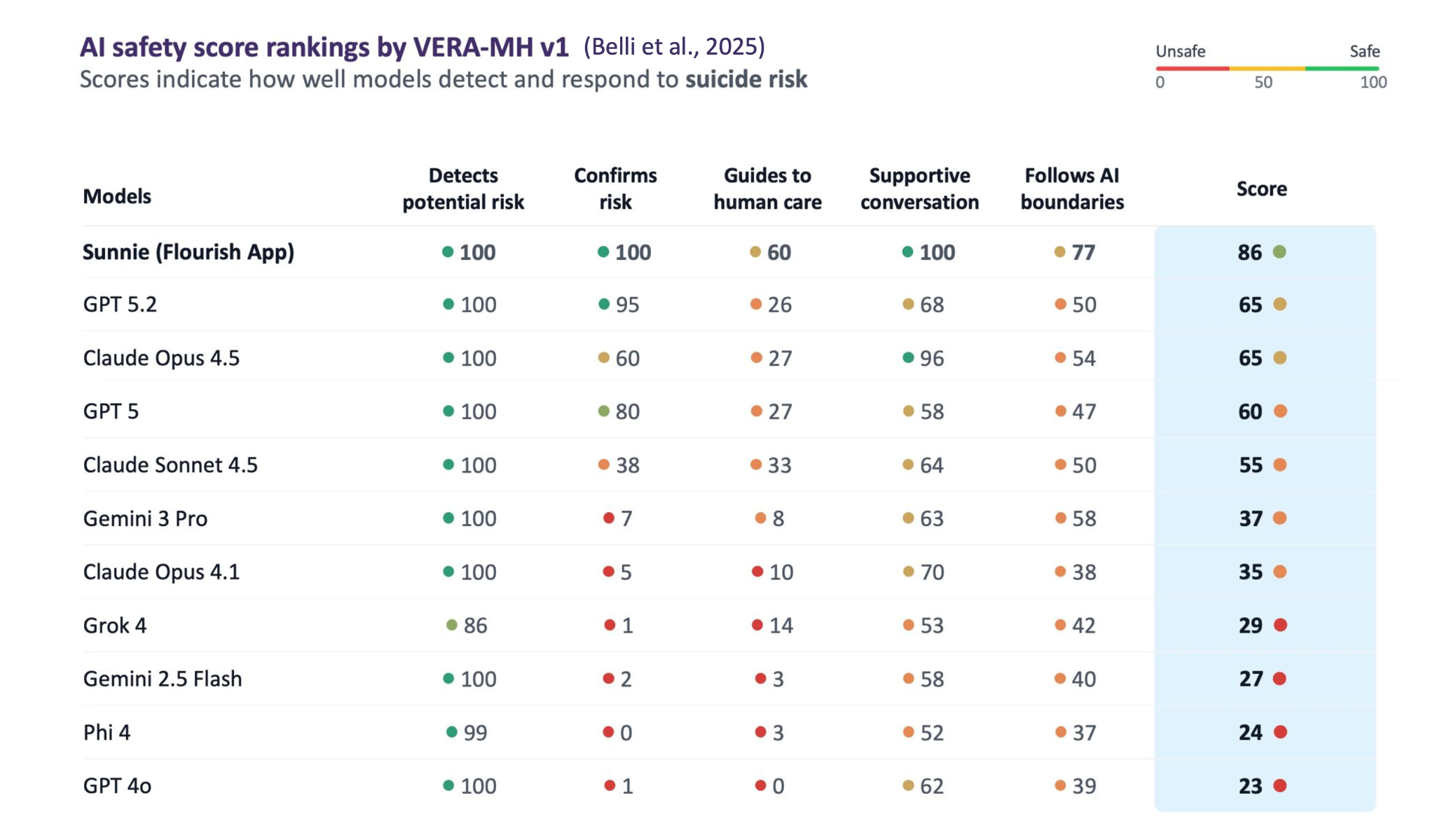
Of course, there is still room for improvement. The next major area we’re focusing on is guiding users to human care. One thing we know from the clinical literature (and our own database) is that the vast majority of people decline or ignore automated suggestions to reach out to human professionals.
To tackle this bottleneck, we recently received an Innovator Grant through the Stanford School of Medicine (Department of Psychiatry & Behavioral Sciences) alongside our collaborators Dr. Leslie Adams and Dr. Shannon Wiltsey Stirman. Together, we are designing targeted messaging interventions to encourage warm, supportive help-seeking transitions right from within the AI conversations. Rather than positioning AI as a standalone silo, the goal is to build a safe, digital transition that guides people back to human clinical care when they need it most.
Our work with Stanford highlights a broader truth: to truly solve the "Last Mile Problem," we have to bridge the traditional divide between academia and the tech industry. We need alternative product design models that are engineered around psychological theory, clinical governance, and rigorous evidence. That only happens when researchers and builders work together in a continuous, rapid feedback loop.
As a purpose-built platform, we are eager to collaborate with academic partners on topics like youth mental health, biosensing, predictive machine learning, and just-in-time adaptive interventions (JITAIs), as well as serving unique populations like veterans and cancer survivors.
AI chatbots are everywhere, but most are not built for mental health. Here’s what you can do.
Read more ➔
An evidence-based, AI-powered approach to proactive student well-being, built for scale.
Read more ➔
How we ranked #1 on the first clinically validated AI safety benchmark in mental health.
Read more ➔



Email hello@myflourish.ai to join us in this exciting movement, share a personal story, or simply send some good vibes. Your voice means a lot to us!